1
Cell membrane

Characteristics
1. Outermost in animal cell and lies next to cell wall in plant cell.
2. Possesses fine pores.
3. Semipermeable membrane made up of lipoproteins.
Functions
1. Separates contents of cell from its surroundings.
2. Regulates the entry of certain solutes and ions.
3. Maintains shape of the cell in animal cell.
2
Cytoplasm

Characteristics
1. Contains a mixture of water and soluble inorganic and organic compounds and various organelles.
Functions
1. Initial steps of respiration takes place here.
2. Contains different organelles, which perform different function.
3
Cell membrane and nucleus
Cell
The basic structural and functional unit of life.
Cell membrane
It is the semipermeable membrane that forms the boundary of the cytoplasm. It is present in all kinds of cells.
Nucleus
The nucleus is a membrane-bound (have a membrane cover) structure of the cell that contains the information for cell growth and reproduction.
Cytoplasm
It is the fluid which fills the entire cell. All the chemical reactions of the cell occur in the cytoplasm.
4
Difference between multicellular and unicellular organisms
The unicellular and multicellular organisms have the following differences:
| Unicellular organisms | Multicellular organisms |
| The entire organism is made of a single cell (e.g. bacteria, protists, some fungi). | These organisms are made of multiple (many cells) (E.g. Most fungi, plants and animals). |
| All the functions necessary for life are performed by the single cell. | Different cells perform different functions and work together to support life. |
| They divide and multiply continuously. | Cells divide (division is slower) and differentiate. But after differentiation, some specialized cells stop dividing. |
| The single cell in these organisms is always exposed to the surrounding environment. | As they have many cells, only the cells on the surface are exposed to the surrounding environment. |
| Regeneration (ability to make lost body parts) is present. | Regeneration is seen only in some multicellular organisms but in most of these organisms, regeneration is absent. |
| Since the single cell has to carry out all the life processes; unicellular organisms have a short lifespan. | Multicellular organisms have a longer lifespan than unicellular organisms. |
5
Nucleus

Characteristics
1. Largest cell organelle, mostly spherical and dense.
2. Nuclear membrane with pores to allow substance to enter and leave.
3. Contains network of thread-like structures, called as chromatin fibres, which contain DNA.
Functions
1. Regulates cell functions.
2. If removed, the cell dies.
3. Contains chromosomes.
6
Difference between chromosome and chromatin
The difference between chromosome and chromatin are as follows:
| Chromosome | Chromatin |
| Chromosomes are condensed parts of the nucleoprotein complex. | It is uncondensed part of nucleoprotein complex. |
| Chromosomes are observed during M-phase or nuclear division. | Chromatin is observable in the interphase nucleus. |
| Chromosomes are mainly meant for distribution of genetic informations to the daughter cells. | It is active in controlling metabolism and other activities of the cell. |
7
Types of chromosomes based on the position of centromere

Based on the position of centromere, chromosomes are of four types:
1. Telocentric: Centromere present at the terminal point of the arm of the chromosome.
2. Acrocentric: Centromere present close to one end of chromosome; this makes one arm of the chromosome very long and the other arm very short.
3. Submetacentric: Centromere is present a little away from the centre of the chromosome; two arms of unequal lengths are produced.
4. Metacentric: Centromere present exactly at the centre forming equal arms of the chromosome.
8
Mitochondria

Characteristics
1. Double walled, inner wall thrown into cristae.
2. Have their own DNA and ribosome.
Functions
1. Synthesises respiratory enzyme.
2. Releases energy from pyruvic acid produced in cytoplasm in the form of ATP.
9
Golgi apparatus
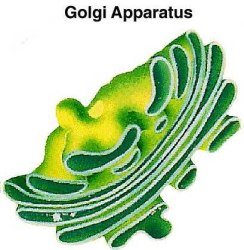
Characteristics
1. Stacks of flattened membrane sacs.
2. Consists of tubules, vesicles and vacuoles.
Functions
1. Synthesis and secretion of enzyme, hormones etc.
2. Formation of acrosome of sperm.
10
Plant cell and animal cell

The difference between plant and animal cells are as follows:
| Feature | Plant cells | Animal cells |
| Cell wall | Present (formed of cellulose) | Absent |
| Centrosome | Absent | Present |
| Vacuoles | Prominent, one or more concerned with excretion and secretion. | Small and temporary |
| Plastids | Present | Absent |
| Size | Large | Small |
| Shape | Rectangular (fixed shape) | Round (irregular shape) |
| Cytoplasm | Dense | Denser and granular |
| Chloroplast | Plant cells have chloroplasts because they make their own food. | Animal cells don’t have chloroplasts. |
| Plasma Membrane | Cell wall and a cell membrane | Only cell membrane |
| Centrioles | Only present in lower plant forms | Present in all animal cells |
11
Ultrastructure of chloroplasts

Ultrastructure
1. A chloroplast has three parts: envelope, matrix and thylakoids.
2. Pyrenoids and stigma are two additional structures present in the chloroplasts of some algae.
Function of chloroplasts
1. Photosynthesis
2. Energy transduction
3. Consumption of carbon dioxide
4.Storage of starch
5. Photosensitivity
6. Reducing power
7. Synthesis of fatty acids
12
Centrosomes

Characteristics
1. A region surrounding centrioles, located near nucleus
2. Contains one or two centrioles
3. Centrioles are surrounded by microtubules
Functions
1. Initiates and regulates cell division
2. Forms spindle fibres, with the help of asters
13
Centriole
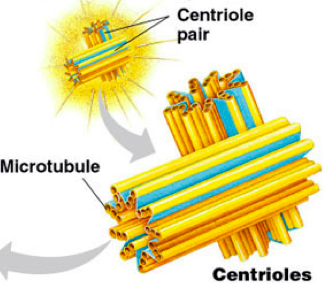
Structure
1. A centriole is a small set of microtubules arranged in a specific way.
2. There are nine groups of microtubules.
3. When two centrioles are found next to each other, they are usually at right angles.
4. The centrioles are found in pairs and move towards the poles (opposite ends) of the nucleus when it is time for cell division.
Functions
1. They help in cell division by forming microtubule-organising centres.
2. Centrioles can be transformed into basal bodies.
3. Basal bodies from the centrioles gives rise to cilia and flagella.
14
Cilia and flagella
Functions of cilia and flagella
1. They help in locomotion in flagellate and ciliated organisms.
2. They create current for obtaining food from aquatic medium.
3. They can function as sensory organs.
4. They show sensitivity to changes in light, temperature and contact.
5. Ciliated larva take part in dispersal of the species.
15
Components of bacterial cell

A bacterial cell consists of following components:
1. Cell envelope (glycocalyx, cell wall, plasma membrane)
2. Cytoplasm (mesosome, ribosome, chromatophores)
3. Nucleoid
4. Plasmids
5. Inclusion bodies (gas vacuoles, inorganic inclusions, food reserve)
6. Flagella
7. Pili
8. Fimbriae
 NEET CRACKER