1
Macronutrients
1. Nutrients that are required in large quantities are called macronutrients.
2. Primary (macro) nutrients are nitrogen, phosphorus and potassium. They are the most frequently required in a crop fertilization program. Also, they need the greatest total quantity by plants as fertilizer.
2
Micronutrients
1. The nutrients which are required in small quantities are called micronutrients.
2. The micronutrients are boron, chlorine, copper, iron, manganese, molybdenum and zinc.
3. These plant food elements are used in very small amounts, but they are just as important to plant development and profitable crop production as the major nutrients.
3
Criteria for essentiality of mineral elements
1. It is dispensable for the growth of plants.
2. The element is directly involved in the metabolism of plants.
3. The element cannot be replaced by any other element.
4. The element alone can correct the disorders produced by its absence or deficiency.
4
Toxicity of micronutrients
1. In higher doses, micronutrients become toxic.
2. Any tissue concentration which reduces the dry weight of tissue by 10% is called toxic concentration.
5
Transportation of food and other substances
1. Excess of food is taken into the storage organs like roots, fruits and seeds.
2. This process is known as translocation and it takes place through phloem in upward as well as downward directions.
3. In flowering season, sugar stored in the roots or stem is translocated to the buds for growing them into flowers.
6
Soil as reservoir of essential elements
1. Soils are derived from rock by processes of weathering.
2. Bulk of materials that are essential for the growth and development of plants become available to roots due to weathering and breakdown of rocks.
3. These processes augment the soil with dissolved ions and inorganic salts.
4. Soil not only supplies minerals but also harbours nitrogen-fixing bacteria, other microbes, hold water, supplies air to the roots and acts as a matrix that stabilizes the plant.
7
Nitrogen cycle

1. The nitrogen cycle involves three major steps: nitrogen fixation, nitrification, and denitrification. It is a cycle within the biosphere that involves the atmosphere, hydrosphere, and lithosphere.
2. Nitrogen fixation is an anaerobic (without oxygen) process in which atmospheric nitrogen (N2) is reduced to NH3. Bacteria are responsible for this process. Bacteria in terrestrial and aquatic (water) environments participate in this process.
3. Nitrification involves two steps. First, the ammonium ion (NH4+) is oxidized into NO2−. Then, this compound is further oxidized into NO3−. Again, bacteria in the soil participate in both processes.
4. Assimilation: Plant roots assimilate nitrogen mainly in the form of nitrates while animals assimilate their nitrogen by eating the plants.
5. Ammonification: Ammonia is formed in the soil by the decomposition of plants and animals and by the release of animal waste.
6. Denitrification: This is the reduction of nitrates to gaseous nitrogen. Denitrifying bacteria perform almost the reverse of the nitrogen-fixing bacteria.
8
Biological Nitrogen Fixation
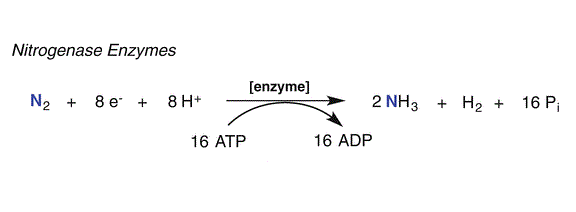
1. The process of reduction of atmospheric nitrogen (N2) to ammonia (NH3) by living organisms such as microbes.
2. Carried out by nitrogen-fixing bacteria, which have nitrogenase enzymes in them.
3. The overall reaction for nitrogen fixation can be given as shown.
4. Symbiotic nitrogen fixation – Shown by the bacteria which has a symbiotic relationship with the roots of plants. They form nodules on roots for this purpose (Eg. Rhizobium and legume roots)
9
Nitrogen Fixation – Nodule Formation

1. Plants such as soyabean show a symbiotic relationship with Rhizobium bacteria to carry out nitrogen fixation.
2. These bacteria will infect the soybean roots, causing them to curl and the inner cortex will divide, causing the roots to form nodules.
3. The process of nodule formation can be described as shown in the figure.
10
Structure and importance of Rhizobium
The structure of Rhizobium are as follows:
1. Rhizobium is a pinkish rod-like bacterium.
2. It possesses two cell membranes inside the cell wall.
3. It is soil bacteria and develops symbiotic relationships with leguminous plants.
It plays an important role such as:
a) Nitrogen fixation: It develops root nodules in the plant. Inside the nodule, bacteria releases an enzyme called nitrogenase. This enzyme helps to convert atmospheric nitrogen to nitrates, nitrites, amino acids and supply it to the plants.
b) Biofertilizer: As Rhizobium has nitrogen-fixing properties, used as fertilizer in agriculture.
 NEET CRACKER