1
Division – Thallophyta
1. Most primitive and the largest division of Cryptogams.
2. Plant body is not differentiated into roots, stem and leaves and such a plant body is termed as thallus.
3. Unicellular or multicellular and autotrophic nutrition.4. For example, Ulothrix, Cladophora, Chara, Spirogyra, Ulva.
2
General characteristics of Bryophyta
1. The plant body is a gametophyte. They grow in areas which are in between the aquatic and terrestrial habitats i.e. amphibious zone and hence known as amphibious plants.
2. They have thalloid or leafy multicellular green plant body.
3. The plant body lacks true roots, stem or leaves.
4. The plants are green and possess chloroplasts.
5. They show autotrophic mode of nutrition.
6. Vascular tissues are completely absent.
7. Sexual reproduction is oogamous.
8. Male reproductive organ is known as antheridium. It is a club shaped structure being borne by a narrow stalk. It produces biflagellate and motile male gametes or antherozoids.
9. The female sex organ is known as archegonium. It is a flask shaped structure having a swollen base and a narrow neck.
10. Water is essential for fertilization.
3
Characteristics of Funaria
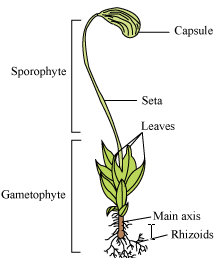
1. Funaria is known as common moss or green moss or cord moss.
2. The main plant body of Funaria is gametophyte and is of two forms.
(a) Juvenile form (creeping protonema)
(b) Adult form (leafy gametophore)3. Protonema is the branched filamentous portion which is produced by germination of spores. It is ephemeral or short lived.
4. Leafy gametophore develop from buds produced on protonema and is made up of axis with spirally arranged leaves. It is 1-3 cm in height, green and is monopodially branched. The main branch of leafy gametophore bears male reproductive organs, e.g., antheridia and the side branch is female branch.
4
Uses of Bryophyta
The uses of Bryophyta are as follows:
1. Prevention of soil erosion
2. Soil formation
3. Water retention
4. Peat
5. Used as food for animals, mammals, birds
5
Division: Pteridophyta
1. Multicellular and autotrophic plants.
2. Body is differentiated into root, stem, and leaves.
3. Vascular system present.
4. Reproduction is asexually through spores and sexually by the formation of gametes.
5. Examples: Adiantum, Lycopodium, Marsilea, Selaginella.
6
Economic importance of Pteridophyta
1. Food
2. Soil binding
3. Scouring
4. Nitrogen fixation
5. Medicines
6. Ornamentals
7
Division – Gymnosperms
1. Evergreen, perennial, have unbranched stem and conifer leaves
2. Do not have an outer covering or shell around their seeds i.e., have naked seeds3. Bear separate male and female spore-producing structures called cones.
4. Do not produce fruits and flowers
5. Examples: Pinus, Cycas, Cedrus
8
Economic importance of Gymnosperm
Economic importance of Gymnosperms is as follows:
1. Edible seeds
2. Timber
3. Paper
4. Fibre boards
5. Linoleum
6. Resin
7. Ephedrine
9
General characteristics of Angiosperms
1. Angiosperms live in a wide variety of environments, from fresh water to the desert and from the very cold Arctic regions to very hot tropical regions.
2. The dominant life stage in alternation of generation is the diploid sporophyte.
3. The haploid gametophyte is small, without chlorophyll, and dependent on the sporophyte.
4. They are heterosporous and produce microspores and megaspores.
5. Angiosperms produce seeds that are covered or enclosed within an ovary.
6. When mature, the ovary constitutes the fruit.
7. Angiosperms are vascular plants and possess xylem and phloem.
8. They possess true leaves, true stems and true roots.
10
Characteristics of monocots
1. They are characterized by the presence of one cotyledon in the seed, generally parallel venation in leaves.
2. For example, cereals, grasses, bamboos, lilies, etc.
11
Characteristics of dicots
1. They are characterized by the presence of two cotyledons in the seed, generally reticulate venation in leaves.
2. For example, Pea, rose, mustard, cotton, etc.
12
Plant life cycle and alternation of generation

1. Alternation of generations is a term primarily used to describe the life cycle of plants.
2. A multicellular gametophyte, which is haploid with n chromosomes, alternates with a multicellular sporophyte, which is diploid with 2n chromosomes, made up of n pairs.
3. A mature sporophyte produces spores by meiosis, a process which reduces the number of chromosomes to half, from 2n to n.
 NEET CRACKER