1
Epithelial tissue
1. Epithelial tissues act as a barrier to keep the different body systems separate.
2. It forms a lining all over the body of the organism and protects the inner lying parts.
2
Glandular epithelium
1. Epithelial tissue folds inward to form a multicellular gland. This structure is called the glandular epithelium.
2. Its function is to secrete substances, like sweat, oil, etc.
3
Stratified squamous epithelium

1. The cells are arranged in a pattern of layers.
2. They are found in the outer layer of skin and cornea.
3. The major function of this tissue type is protection, as it is found in areas that undergo wear and tear.
4
Cuboidal epithelium

1. Consists of cubical (cube-shaped) cells.
2. It is found in the lining of the kidney tubules, salivary glands and thyroid glands, where it provides mechanical support.
3. It plays an important role in secretion and absorption.
5
Columnar epithelium
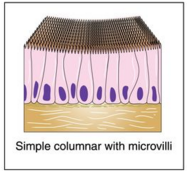
1. Consists of tall, rectangular or column-shaped cells (cylindrical cells).
2. It is found in the lining of the stomach and intestines.
3. It facilitates the movement of nutrients across the epithelial barrier.
6
Types of muscles

There are three kinds of muscles. They are
1. Striated (skeletal, striped or voluntary) muscle: For example, arms, legs, neck, face etc.
2. Unstriated (smooth, unstriped or involuntary) muscle: For example, iris of the eye, muscle, skin, urinary bladder, uterus etc.
3. Heart or cardiac muscle: For example, walls of the heart.
7
Connective tissue
1. The cells of connective tissue are loosely scattered in a matrix.
2. The matrix can be a fluid, jelly like, dense or rigid. The nature of matrix depends on the function a connective tissue serves.
3. The role of connective tissue is to protect, support, and bind together parts of the body.
8
Tendons, ligaments, adipose tissue
Tendons
1. Tendons are tough and non-elastic and provide great strength and limited flexibility.
2. It is fibrous connective tissue that usually connects muscle to bone.
Ligaments
1. The ligament is the fibrous connective tissue that connects bones to other bones.
2. They are tough, elastic, and provide strength and flexibility.
Adipose tissue
1. Adipose tissue is composed of fat globules.
2. This tissue is found below the skin.
3. It provides insulation and works as a cushion.
9
Nervous tissue

1. Itis composed of specialized cells called a neuron.
2. It works in coordinating the organs of the body by generating impulses.
3. Each neuron is composed of cell body, axon and dendron.
10
Morphology of cockroach
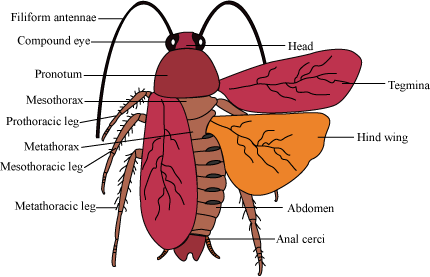
1. The cockroach, Periplaneta americana, is a common nocturnal omnivorous household pest, commonly found in damp and warm places.
2. The body is elongated, segmented, bilaterally symmetrical, flattened dorsoventrally and reddish-brown in colour.
3. It is covered by a hard brown-coloured jointed exoskeleton.
4. It is divisible into three parts, head, thorax and abdomen.
5. Head consists of 6 segments fused together.
6. At its upper side, it bears two large compound eyes.
7. A pair of antennae is present in the antero-medial indentation of the eyes.
8. The mouth is situated at the lower end of the head.
9. The mouth parts are of the chewing type, consisting of labrum, mandibles, maxillae, labium and hypopharynx.
10. The thorax consists of three segments, an anterior prothorax, a middle mesothorax and a posterior metathorax.
11. Each segment bears a pair of walking legs and mesothorax and metathorax also bear each pair of wings.
12. The abdomen is broad consisting of ten segments.
11
Anatomy of cockroach
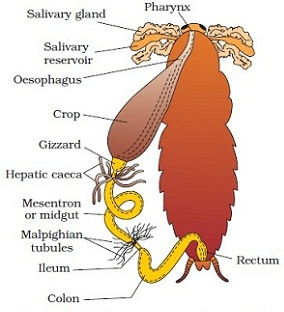
1. The body wall of cockroach consists of cuticle, epidermis and basement membrane.
2. The body cavity is filled with blood – like fluid and therefore, called haemocoel.
3. The digestive system includes alimentary canal and associated digestive glands.
4. The blood vascular system is of open type. The heart is 13 chambered.
5. The respiratory system is well developed and consists of spiracles, tracheae and tracheoles.
6. The nervous system comprises of central, peripheral and sympathetic nervous system.
7. Sense organs include a pair of compound eyes, thigmoreceptors, chemoreceptors, auditory receptors and proprioreceptors.
8. The principle excretory organs of cockroach consists of malpighian tubules. Fat bodies and nephrocytes also help in excretion.
 NEET CRACKER