1
Birth rate / natality and death rate / mortality
1. Natality rate is defined as number of births per 1000 individuals per year. Thus, a natality rate of 10.0 (out of 1,000) in a population of 1,000 would mean 10 births per year in that entire population, or 0.1% out of the total.
2. Mortality rate is defined as number of deaths per 1,000 individuals per year. Thus, a mortality rate of 10.0 (out of 1,000) in a population of 1,000 would mean 10 deaths per year in that entire population, or 0.1% out of the total.
2
Exponential growth model
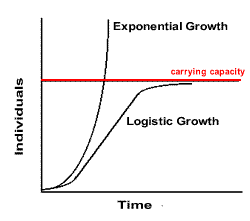
1. The exponential form is used when populations reproduce continually and soon attain its full potential rate (e.g., humans).
2. Population of a particular habitat grows exponentially or geometrically when unlimited resources are available.
3. J shaped curve is obtained.
3
Logistic growth model

1. Logistic population growth occurs when the growth rate decreases as the population reaches carrying capacity.
2. Carrying capacity is the maximum number of individuals in a population that the environment can support.
3. Sigmoid curve is obtained.
4
Population interaction
1. Commensalism is the relationship between individuals of two species of which one is benefited and the other is almost unaffected. For example, pilot fish and shark.
2. Proto-cooperation is an association between individuals of two species, each of which is benefitted by the presence of the other but can live equally well without association. For example, birds and cattle.
3. Mutualism is an association between individuals of two species, both of which are benefited but can not live separately under neutral conditions. For example, termites and flagellates.
4. Amensalism is an interaction in which one species causes harm to another species with its toxic secretion, often without gaining any benefit from the interaction. For example, moulds.
5. Parasitism is an association of two organisms of different sizes and species in which the smaller one is benefited and the large one is harmed.
6. Predation is the interaction between two species, one of which captures, kills and eats up the other.
5
Age pyramid
1. The model representing geometrically the proportion of different age groups in the population of any organism is called age pyramid.
6
Types of age pyramid
1. Pyramid with broad base
2. Bell shaped polygon
3. Urn shaped
7
Carrying capacity
1. The carrying capacity is the size of a population that can live indefinitely using the resources available where that population lives.
8
Allen’s rule
1. Animals of colder areas have shorter extremities (e.g., tail, ear, feet) as compared to animals to warmer areas.
9
Responses to abiotic factors
1. Regulation: They maintain homeostasis by ensuring constant body temperature (thermoregulation), and constant osmotic concentration (osmoregulation). For example, mammals regulate temperature by shivering in cold and sweating in heat.
2. Conformation: The internal environment of conformers changes with external environment.
3. Migration: It is a movement from stressful habitat temporarily to hospitable area and return when stressful period is over. For example, migration of birds to Keolado National Park, Rajasthan from Siberia.
4. Suspension: In this, the organisms develop mechanisms to deal with stressful situations. For example, spores (bacteria and fungi).
 NEET CRACKER