Animal Tissue – Types, Structure
The animal cells are grouped together to form animal tissues. These tissues vary in their structure, function, and origin. The animal tissues are divided into epithelial, connective, muscular and nervous tissues. Let us have a glimpse of each type of animal tissue in detail.
Types of Animal Tissue
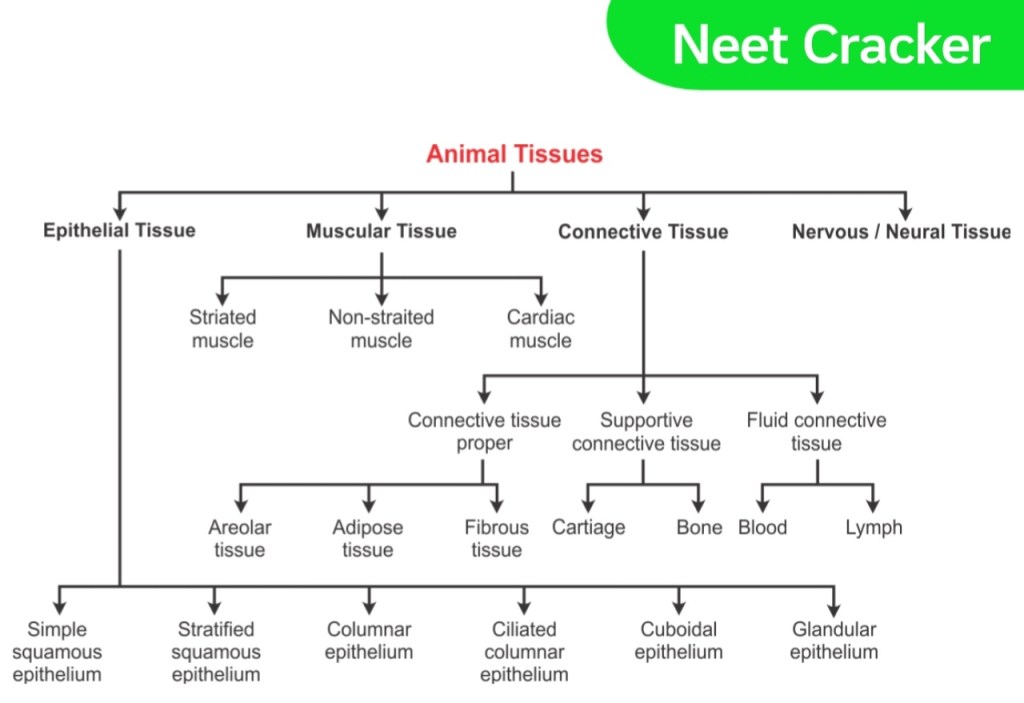
Epithelial Tissue
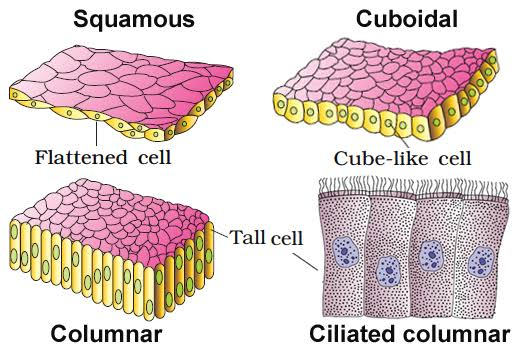
Epithelial tissues form the protective covering and inner lining of the body and organs. These tissues were the first to evolve during evolution and were first formed during embryonic development. They develop from the ectoderm, mesoderm and endoderm of the embryo.
Characteristics of Epithelial Tissues
Following are the important characteristics of epithelial tissues:
- These can be single-layered or multi-layered.
- The tissues have the power to regenerate.
- These are held together by gap junctions, tight junctions, zonula adheren, desmosomes, or interdigitation.
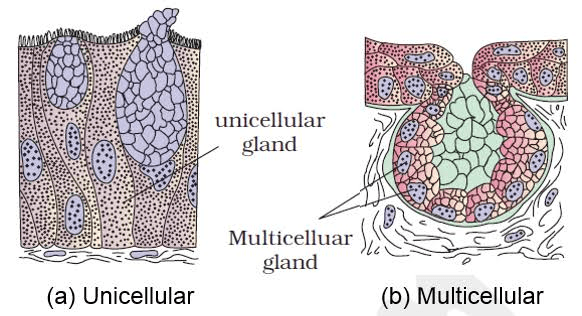
- The plasma membrane of these cells is specialized into flagella, cilia, and microvilli.
Classification of Epithelial Tissues
The epithelial tissues can be classified as:
| Classification | Function |
| Sensory epithelium | To perceive stimuli |
| Glandular epithelium | Secretes chemicals |
| Pigmented epithelium | Imparts colour in retina |
| Absorptive epithelium | For absorption |
Connective Tissue
Connective tissues develop from the mesodermal cells of the embryo. they support and bind other tissues in the body. These are made up of three components:
- Intercellular Matrix: It is made up of mucopolysaccharide, specifically hyaluronic acid.
- Cells: The major cells include fibroblasts, adipocytes, plasma cells and mast cells.
- Fibres: Connective tissues are made up of three types of fibres, namely, collagen fibre, elastic fibre, reticular fibre.
The connective tissues perform the following functions:
- They attach organs and tissues together.
- They store fat in the form of adipose tissues.
- They help in repairing tissues.
- They prevent the organs from mechanical shocks.
- The organs also help in defence.
Classification of Connective Tissues
The connective tissues are classified as follows:
| Classification | Function |
| Connective Tissue Proper | Provides support and protection to the body |
| Vascular Tissue | Transport of materials in the body |
| Skeletal Tissue | It supports the body and gives it proper shape and form |
Muscle Tissue
The muscular tissue develops from the mesoderm of the embryo. It is classified into three types:
- Cardiac
- Smooth
- Skeletal
Muscular tissue performs the following functions:
- It helps in movement and locomotion.
- It supports the bones and other structures.
- It is responsible for peristalsis and parturition.
Classification of Muscular Tissue
The muscular tissue can be classified as:
| Classification | Function |
| Cardiac | It helps in blood circulation and keeps the heart pumping |
| Smooth | These help in peristalsis and other involuntary functions of the body. |
| Skeletal | Provide support, help in movement and maintain homeostasis |
Nervous Tissue
Nervous tissue makes up the peripheral and the central nervous system. It develops from the ectoderm of the embryo. It possesses the ability to initiate and transmit the nerve impulse. Its main components include:
- Neurons – These are the structural and functional unit of nervous system. It comprises an axon, cell body and dendrites.
- Neuroglia – These are special cells found in the brain and spinal cord. They provide support to the neurons and fibres.
- Neurosecretory Cells – These function as endocrine organs. They release chemical from the axons direcly into blood

